Monday, June 4, 2012

Hosni Mubarak Sentence: A Joke On The Revolution

Egyptians protesting against the sentence announced by the court. Courtesy Reuters


Revolutionists has returned in Egypt, this time they are frustrated, demoralized and shattered by the verdict announced on 3rd of June in the trial of Mr. Hosni Mubarak and his top security officials. They are back in Tahrir square to protest and register their anger to the treatment they have received after the long and hard fought battle.

Hosni Mubarak and his interior minister, Habib Al Adly received life sentences ( instead of getting death sentences as many would have liked ) for brutally suppressing last years revolution which resulted in the killings of 850 Egyptians. Six security officials are acquitted, who worked under the Interior Ministry. Many people are in shock on the acquittal of these officials as well, particularly keeping in mind that they work under the interior ministry and were carrying out the orders of Hosni Mubarak and Habib Al Adly. This can be attributed to the lack of evidence (pointed out by the court) as many of their phone conversations and files have been mysteriously gone disappeared from the Interior Ministry. Hosni Mubarak's sons were also on trial but on the charges of fraud  framed by the prosecution ( which are hard to understand ) and they were acquitted as well. However they still face many fresh charges related to financial  misconduct which includes manipulating the stock markets.

There is no end for the misery of the people of Egypt who fought against the brutal regime last year.  Army is still in control of the government and there is no guarantee of better and peaceful situation after the elected government gets in charge. Especially keeping in mind they are going through a presidential face off between the last Prime Minister under the Mubarak's regime Mr. Ahmed Shafiq and Muslim Brotherhood Candidate Mr. Muhammad Morsi.

The verdict makes the situation worse and Egyptians are feeling cheated. One joke making the rounds has it that Syria’s Bashar al-Assad has agreed to step down if he can be tried in an Egyptian court. The people of Egypt wanted a clean country, free from Mubarak's regime and its tyranny its officials, free from all the people involved in making the situation worse for the Egyptian and strengthening the ex government. Least they wanted a presidential face off between the Last Prime Minister of the Mubarak's regime itself and the Muslim Brotherhood candidate.

Their revolution was an example for the whole Arab community, to look at and get inspired. Most Importantly it was fought and won by the same people who were facing the heat of the regime without any major help from outside. It was the revolution of the century. But as history suggests not all revolutions ends with a happy note, this well may be on its way of getting worse. We from outside can only hope and pray for the revolutionaries and their cause to triumph at the end. 


Friday, June 1, 2012

Greece Debt Crisis Explained

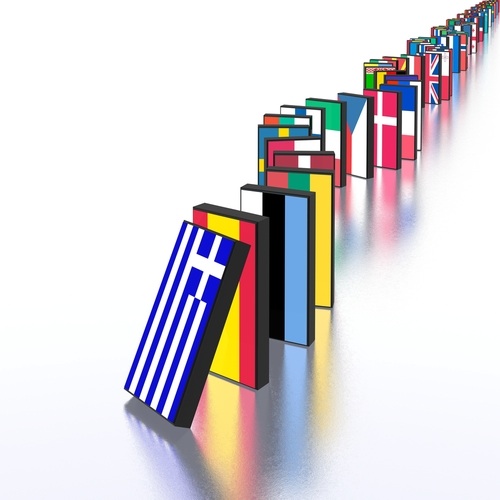
We have heard the name Greece or Greek very often in our childhood days when we were studying history, it is also not uncommon in Hollywood movies. But recently its getting very hot in the field of Finance and economy. So what's this all about, why countries like UK and US has to fear from the debt crisis which is unfolding at a moon's distance from them. Let us go step by step in getting a grasp of the problem as well as its magnitude. 


What is the problem?


The problem with Greece is its accumulated debt. Debt is not actually bad for countries but not able to repay them is a nasty blow. Greece as we all know, is a very developed economy on the expense of their borrowing.They were until very recently, were able to borrow money from the investors cheaply because markets assume the developed countries are guaranteed to repay their loans with the agreed interest rates at a certain time.  This leads to uncheck borrowing of loans by the government and resulted in huge debt. For repaying that debt they need more money. You see its a vicious circle, they go to the same investors to borrow money again, but due to its high debt and a question mark on its availability to repay the loans, investors are demanding higher interest rates. Higher interest rates means they have to pay back much more money than they have actually borrowed. Now the whole Euro-zone, including some other giant economies are fighting tooth and nail to make Greece repay their loan.


How that will happen?


The center of attraction is a lady and its institution i.e. Christine Lagarde and the IMF. They have agreed on a bailout plan for Greece but on the expense of some draconian Austerity Measures proposed to be implemented in Greece by the Government. The Austerity Measures are nothing but a drastic cut on public expenditure and expenses, increase in taxes, long working hours and more or less no free public services like healthcare and education. In march 2011 EU and IMF has given 130 billion euros to Greece as a bailout package but it turns out that is not enough to rescue an economy like Greece. So they have brought a new plan of 110 billion euros, with more stringent policies and draconian laws to present to Greece which will help them to repay their debt. But guess what, citizens of Greece are divided on whether to accept the plan on its face value and bear the consequences of new policies, which Moody's (a rating agency) describes will take Greece into new lows of economy or reject it. The polls of 17th june will surely decide the matter and if the anti austerity party wins they will go back to IMF and try convince them of less stringent actions. 


What will happen if they don't accept the IMF plans or its austerity measures?


Something has to happen as Nobel laureate Paul Krugman says, Greece will leave the euro within 12 months. If they don't accept the bailout package they will not be able to repay their loans and will technically "default". Then Greece will be forced to opt out of Euro zone and go back to their old currency "Drachma".


What are its implications on Greece?


Well not many in long terms. They will go back to their old currency drachma which will be devalued to a level of 30 to 40 percent. But this does not effect the economy in long terms. Say in 4 - 5 years they will be back on track as their economy thrives on tourism and they have defaulted that means they dont have to pay their loans as well. This scenario as described by many Economists is more viable for Greece than accepting austerity measures which will drive unemployment to a level of 40%. So there is not much for Greece if they choose to default on their loans.


But What will happen to Euro zone?


Here is the catch, By far the biggest losers of any Greek exit would be European taxpayers. That is why they are fighting tooth and nail to make Greece repay them. The Greek central bank owes about 100 billion euros to the other central banks that are members of the euro. If Greece were to default on that debt Germany alone would probably take a hit of about 30 billion. The ECB would surely also take losses on the 56 billion euros of Greek government bonds. Euro-zone members and the International Monetary Fund would also be on the hook if Greece repudiated its bail-out loans. Europe’s disbursed bail-out funds total 161 billion euros, the IMF has lent 22 billion euros. Greece defaulting on their loans will send negative signals to the countries like Spain and Italy which are also under huge foreign debt. A bad scenario will be Spain and Italy defaulting on their loans as well. Greek default will shake the investors nerve and they will surely be unwilling to buy government bonds from other European economies. This will result in an upward spiraling of interest rates and make loans very very costly for governments. Spending will suffer and economies will go into slump or you may call them depression. (Source: The Independent and The Economists)


Borrowing costs in Spain and Italy are rising in response to worries over Greece, frustrating attempts by the Spanish government to reassure investors about the state of its banks. Greece’s crisis has dragged on for two years. Policymakers may now have only weeks, perhaps less, to fix the problem.

To be Continued...........( As the situation progresses)